
India is advancing construction on its first high-speed rail corridor, with the initial section between Surat and Vapi expected to commence passenger services in August 2027.
What is the current construction status?
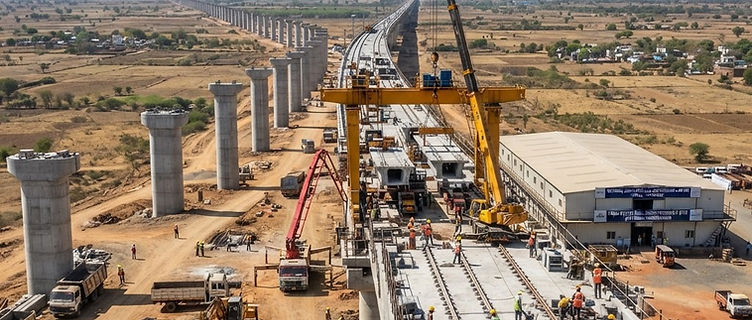
The Mumbai-Ahmedabad High-Speed Rail (MAHSR) project, India's inaugural high-speed rail corridor, is currently in an advanced stage of construction. Managed by the National High-Speed Rail Corporation Limited (NHSRCL), the project is designed to connect the two cities with a line capable of supporting operational speeds of 320 km/h.
Recent milestones include the completion of all 14 portal beams over the Delhi-Mumbai Rajdhani main line in Vadodara, which facilitates the integration of the bullet train viaduct. Additionally, the project is moving forward with the installation of 14 traction substations to power the corridor.
The successful placement of these portal beams marks a significant engineering achievement for the project team, as it required complex coordination with existing railway traffic. These structural elements represent the literal backbone of the elevated corridor, allowing the project to bridge critical junctions safely. For contractors and infrastructure managers, this phase is vital for ensuring that the geometry and structural integrity of the viaduct meet the stringent requirements necessary for high-velocity rail transport.
As the project enters this phase, stakeholders are closely observing the integration between these new structures and the legacy rail network. The installation of traction substations further emphasizes the transition from civil works toward electrical and mechanical outfitting, which is a pivotal shift in the lifecycle of any high-speed infrastructure endeavor.
How is the procurement strategy evolving?
While the project was initially conceived as a full integration of Japanese Shinkansen technology, recent developments indicate a strategic shift toward localization and interoperability. In September 2026, BEML disclosed an order exceeding ₹5,400 crore from NHSRCL for the supply and maintenance of high-speed rolling stock.
This follows an earlier contract awarded to a joint venture of Siemens and DRA Agarwal for the implementation of ETCS Level 2 signalling systems. These moves reflect India's broader 'Make in India' initiative, aiming to develop indigenous high-speed trainsets and standardized infrastructure templates that can be applied to future rail corridors across the country.
Procurement strategies of this nature are designed to foster domestic industrial growth while maintaining the high safety standards required for speeds reaching 320 km/h. By sourcing rolling stock and signalling systems through these partnerships, the project is not only securing necessary technical assets but also creating a framework for local knowledge transfer.
Signalling systems, such as the ETCS Level 2, are foundational to operational safety, managing train movements and speed regulation with precision. For project managers, the selection of these systems dictates the long-term maintenance requirements and training programs for operational staff. The standardization of these components is a common approach in large-scale infrastructure to ensure that future corridors can benefit from economies of scale and uniform maintenance protocols.
When will construction conclude and operations start?
The government has confirmed that the first section of the MAHSR corridor, spanning from Surat to Vapi, is scheduled to open for passenger services in August 2027. This segment serves as a critical testbed for the standardized delivery model that India intends to use for seven additional high-speed rail corridors currently under consideration.
Although the project has faced significant cost escalations and delays due to land acquisition challenges and inflationary pressures, the Ministry of Railways maintains that construction is progressing rapidly to meet the revised 2027 operational target. The establishment of this initial operating segment is a standard procedure in major transport infrastructure to validate system performance before full-scale deployment.
By focusing on the Surat to Vapi stretch, NHSRCL can monitor the actual operational dynamics of the rolling stock and the power supply grid under real-world conditions. This validation process is essential for verifying that the technical specifications established during the design and procurement phases align with the practical requirements of the passenger service schedule.
What are the next steps for the industry?
As the industry looks toward the 2027 opening, attention remains focused on the final stages of track installation, system testing, and staff training, all of which must be synchronized to ensure a reliable service launch. This milestone also provides an opportunity to refine construction methodologies for future corridors, ensuring that the experiences gained during the MAHSR project are utilized to optimize the planning and execution of subsequent rail initiatives.
Project Atlas tracks FEED and FID tracking across every stage of the industrial lifecycle, from announcement to operations. See daily industrial project news for related project and procurement intelligence.