

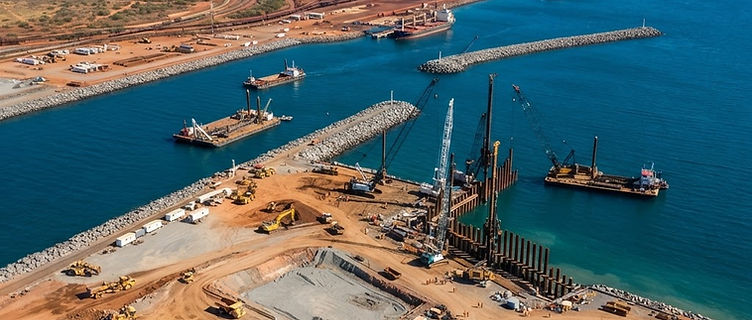
Construction is accelerating at the Lumsden Point port project in Port Hedland, with major landside civil works underway to support future import and export capabilities.
What is the procurement scope?
The Lumsden Point development in Port Hedland has reached a significant construction milestone as work progresses on landside infrastructure. The project, which is supported by a $450 million investment from the Australian Government and $96.6 million from the Western Australian Government, is designed to enhance the port's capacity for handling battery metals, minerals, and renewable energy infrastructure.
The project scope includes extensive landside civil works, which have been awarded to Ertech Pty Ltd. This contract covers the construction of internal roads, the sealing of the causeway, and the installation of critical underground services including power, water, and communications. These works are essential for establishing a robust logistics hub that will connect to the Great Northern Highway.
What is the current construction status?
Recent site activity includes the commencement of piling works for two new multi-use wharfs, with over 280 steel piles scheduled for installation to form the foundation of the new marine facilities. The commencement of piling operations marks a transition from site preparation and earthworks to the primary structural phase of the marine facility.
In the context of large-scale maritime infrastructure, the installation of steel piles is a critical path activity. These foundation elements must be driven to specific depths to ensure the integrity of the wharfs, which will eventually support heavy operational loads and berth deep-draft vessels.
For stakeholders and project managers, this phase is characterized by intensive quality assurance processes. Engineers must verify that each pile meets the structural load requirements and that pile positioning aligns with the precise marine engineering designs developed for the port basin.
What do suppliers need to watch next?
The site development requires high-quality fabrication for various operational components, including steelwork and specialized the fabricator's plant and capability to facilitate efficient cargo handling. By securing a contractor like Ertech Pty Ltd for the civil works package, Pilbara Ports has initiated the foundational connectivity required for the site.
The installation of underground services and the sealing of the causeway represent the enabling works that allow subsequent trade-focused infrastructure to be built atop a stable, serviced platform. For procurement teams, the focus at this stage shifts toward the coordination of supply chains, ensuring that raw materials, structural steel, and mechanical components are delivered to the site in synchronization with the civil progress.
The integration of site services, such as power and communications, is a fundamental step in readying the port for the eventual installation of operational equipment. Project owners monitor these milestones closely as they indicate that the site is evolving from an active construction zone into an integrated facility capable of supporting industrial operations.
The logistical complexity of connecting these new facilities to the Great Northern Highway underscores the importance of regional infrastructure alignment, as the project must seamlessly interface with the existing heavy vehicle corridors that service the wider Pilbara region.
When will the project be operational?
The Lumsden Point project is a key component of the broader strategy to diversify the Port of Port Hedland, transforming it into a more versatile and sustainable gateway for the Pilbara region. The infrastructure is expected to be operational for imports by mid-2026.
Beyond the current civil works, the project includes dredging of channel access and turning basins to accommodate increased vessel traffic. As the facility nears completion, the integration of advanced mining equipment and conveyors will be vital for the efficient movement of bulk commodities and project cargo.
The development is expected to drive significant economic growth and job creation, strengthening regional supply chains and supporting the transition to renewable energy exports. The timeline leading toward the mid-2026 operational target is defined by a series of sequential milestones, starting with the completion of the piling program and moving toward the installation of wharf deck components.
Dredging operations remain a significant technical undertaking that must be managed in parallel with the marine structure construction to ensure that the turning basins and access channels are ready for future vessel movements. For the port authority, the strategic value of Lumsden Point lies in its adaptability, as the facility aims to cater to both existing bulk export requirements and the emerging demands of the renewable energy and battery mineral supply chains.
The focus on mid-2026 indicates a well-structured project schedule that accounts for the complexity of port construction, where marine engineering and terrestrial logistics must converge. As the facility approaches its commissioning phase, the testing of the the fabricator's plant and capability will become the final hurdle, ensuring that the port infrastructure can meet the necessary throughput requirements for its intended cargo profile.
The systematic execution of these phases, from foundational piling and civil servicing to final operational equipment installation, provides the framework for the long-term viability of the project as a diversified gateway for the region. See the industrial companies directory for related project and procurement intelligence.