
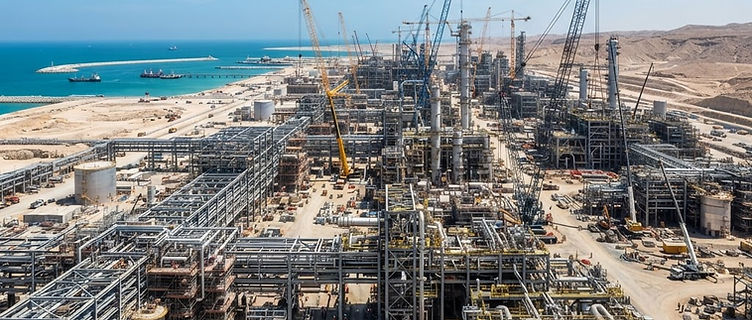
Perdaman Chemicals & Fertilizers has reached 86% overall progress on its Karratha urea manufacturing plant, following the successful delivery of 110 prefabricated modules.
Project Atlas IntelligenceNovember 10, 20263 min read
Project Ceres Construction Progress Perdaman Chemicals & Fertilizers has confirmed that its flagship urea manufacturing facility in Karratha, Western Australia, known as Project Ceres, has reached an overall completion status of 86% as of mid-October 2026. The project, which is set to become Australia’s largest urea plant with a production capacity of 2.3 million tonnes per annum, is currently in an advanced stage of development. Engineering and procurement activities are reported as 99% complete, while yard fabrication has reached 100% completion. Construction progress at the site currently stands at 83%. Achieving an 86% overall completion milestone represents a transition from heavy structural installation to the intensive phases of mechanical, electrical, and instrumentation fit-out. At this juncture, engineering and procurement are effectively concluded, meaning the project has moved past the volatile design-change stage that often plagues large-scale petrochemical developments. With yard fabrication finalized, the focus shifts entirely to the onsite assembly, which is the most labor-intensive portion of the project lifecycle. Verification of this progress is managed through rigid percentage-of-completion reporting based on earned value management, where physical inspections and site surveys confirm that the installed volumes align with the engineering drawings and the master schedule. ## Modular Delivery and EPC Execution A significant milestone was achieved in September 2026 with the completion of the fabrication and delivery of 110 prefabricated modules. These components were manufactured in India by Larsen & Toubro (L&T) and transported to the Burrup Peninsula. The successful integration of these modules, which required rigorous dimensional and quality controls to meet Australian biosecurity and hazardous area standards, highlights the project's reliance on a globalized modularization strategy. The Engineering, Procurement, and Construction (EPC) contract for the facility is being delivered by a 50/50 joint venture between Clough and Saipem. The execution of this modular strategy is a critical element in managing the inherent risks of constructing high-complexity petrochemical plants in remote regions. By shifting fabrication to a centralized facility in India, the project team minimizes onsite man-hours, which in turn reduces the logistical burden on the Burrup Peninsula. For the Clough-Saipem joint venture, managing the interface between these international modules and the domestic site conditions is a central technical challenge. Quality control and compliance with Australian standards represent a primary focus, particularly regarding the integrity of structural connections and piping interfaces once modules are positioned on their final foundations. The successful delivery of 110 modules indicates that the primary supply chain risk associated with large-scale equipment fabrication has been mitigated. ## Strategic Context and Future Outlook Project Ceres is positioned as a transformative development for Australian manufacturing, aimed at extracting value from natural resources while supporting national decarbonization goals. The facility is designed to incorporate advanced technology for environmental efficiency, including a low-emission power plant. Beyond the urea plant, the Western Australian and Federal governments have recently initiated a joint $4-million pre-feasibility and pre-FEED study to evaluate the potential for a new large-scale conventional crude oil refinery in Karratha. While the refinery project remains in the preliminary study phase, it underscores the region's growing role as a hub for advanced petrochemical and fuel processing infrastructure. For stakeholders, the focus now turns to commissioning and startup planning. As the construction phase at 83% approaches its conclusion, the EPC contractor and the owner must coordinate the transition from construction management to pre-commissioning, which involves pressure testing, loop checks, and the functional testing of critical safety systems. The timing of these activities is essential for ensuring that the commissioning sequence aligns with utility availability and feedstock readiness. The industrial significance of the Burrup Peninsula continues to expand, as evidenced by the additional government-led pre-feasibility studies for refinery infrastructure. These developments reflect a regional strategy to integrate primary resource extraction with downstream value-added processing, aiming to improve domestic supply chain resilience. The oversight of these projects requires careful attention to regulatory compliance and technical integration, as the facility nears its final operational commissioning. For management, the final 14% of work remains the most scrutinized, as it involves the integration of complex software systems with physical plant infrastructure to achieve production capacity targets.
Project Atlas tracks EPC procurement across every stage of the industrial lifecycle, from announcement to operations. See the interactive industrial project map for related project and procurement intelligence.
Frequently Asked Questions
Sources
- https://perdamanchemicalsandfertilisers.com/project/project-ceres
- https://www.hydrocarbonprocessing.com/news/2026/09/lt-completes-fabrication-and-delivery-of-110-modules-for-australia-s-largest-urea-plant
- http://www.ogj.com/refining-processing/news/55394580/australia-launches-pre-feasibility-pre-feed-study-for-grassroots-refinery
#Petrochemicals#Western Australia#Perdaman#Urea#Construction#Karratha#Australia
