

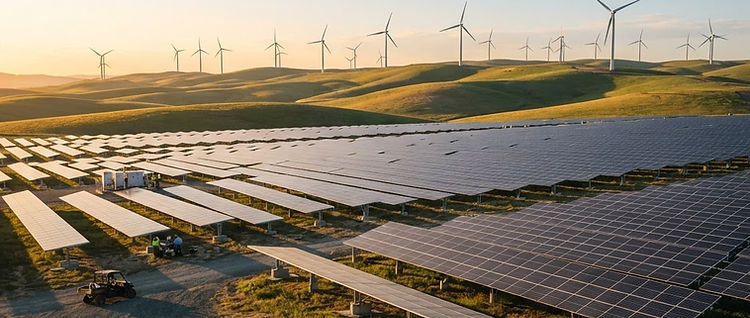
Renewable energy is generated from naturally replenishing sources, principally solar, wind, hydro, geothermal and bioenergy. Over the past decade it has moved from a niche, subsidy-dependent segment to the cheapest source of new generation in most markets, and it now accounts for the majority of new power capacity added worldwide each year.
Utility-scale solar and onshore wind dominate deployment volumes, while offshore wind has become the preferred route to large-scale capacity in densely populated coastal markets. Hydro provides flexible, long-duration output alongside storage; geothermal offers firm low-carbon baseload in suitable geologies; and bioenergy is used for dispatchable generation and industrial heat. Hybrid projects combining generation, storage and grid services are increasingly standard.
Recent activity has been shaped by falling module and turbine costs, competitive auctions and corporate power purchase agreements. Record deployment has concentrated in China, the United States, India, Brazil and Europe, with emerging capacity in the Middle East, Southeast Asia and Africa. Offshore wind has scaled into multi-gigawatt programmes, and floating foundations are opening deeper-water sites that were previously uneconomic.

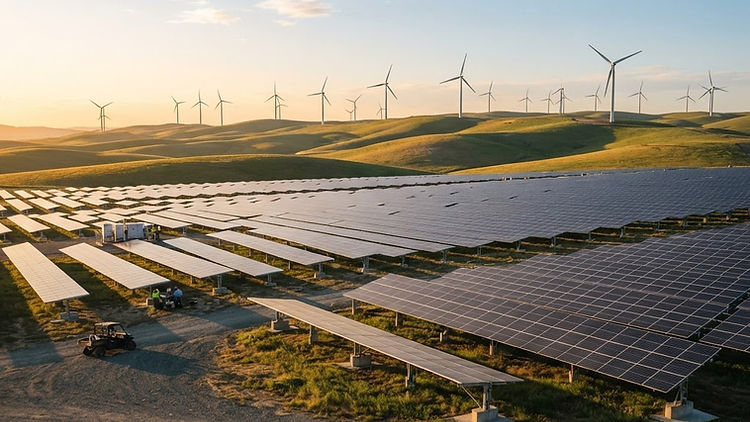
Development follows a well-defined path: site and resource assessment, environmental and planning consent, grid connection, offtake or auction award, financing, construction and commissioning. Consent and grid access consume most of the development timeline, and the commercial structure, whether a feed-in tariff, contract for difference, auction or corporate power purchase agreement, determines the revenue certainty required by lenders.
Procurement centres on modules, trackers, inverters, turbines, towers, blades and balance of plant, together with civil works, cabling, substations and increasingly battery storage. Long-lead grid equipment and installation vessels constrain schedules, and suppliers face pressure to demonstrate lower carbon content, recyclability and secure supply chains as buyers scrutinise embodied emissions.
The modern renewable era began with the commercialisation of wind and solar in the 1990s and 2000s, then accelerated dramatically through the 2010s as manufacturing scale drove costs down. Policy support, initially through feed-in tariffs and later through auctions, moved the sector from demonstration projects to routine utility-scale construction within a single generation.

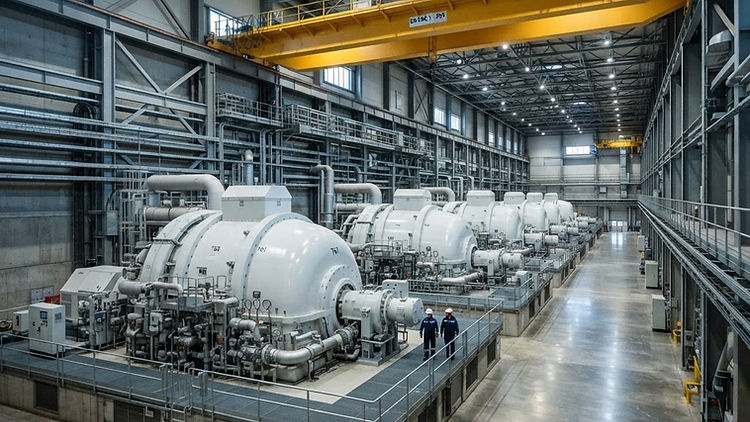
Future prospects are strong but not without friction. Renewables are expected to supply most new capacity for decades, supported by electrification, industrial decarbonisation and government targets, yet permitting delays, grid congestion, supply chain concentration and critical mineral availability all constrain the pace. Project Atlas tracks renewable projects from announcement and financing through EPC, grid connection and commissioning, flagging procurement signals for turbines, modules, balance of plant and storage as projects advance.
Supply chains remain concentrated. Module manufacturing, cells, wafers and polysilicon are dominated by a small number of producers, and offshore wind turbines, installation vessels and high-voltage cables face comparable constraints. Buyers increasingly demand diversified sourcing, traceable materials and domestic content where incentives require it, which is redrawing where new factories are built.
For suppliers, the commercial opportunity depends on timing. Packages for modules, turbines and balance of plant are released after financing closes, whereas grid equipment and installation contracts are often reserved during development to protect the construction programme. Tracking consent milestones and auction results is therefore as important as tracking project announcements.
Explore Renewable Energy projects
Browse live projects, tenders and procurement activity in this sector.
View projects