
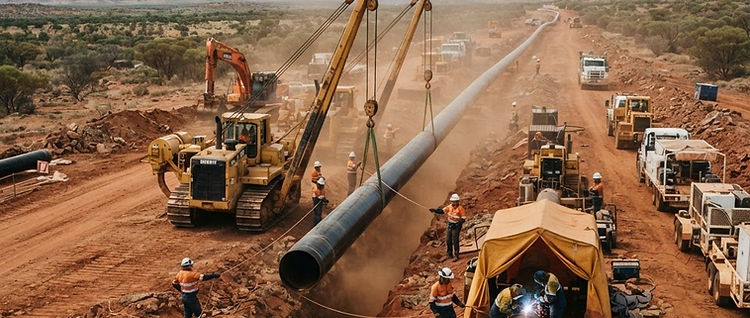
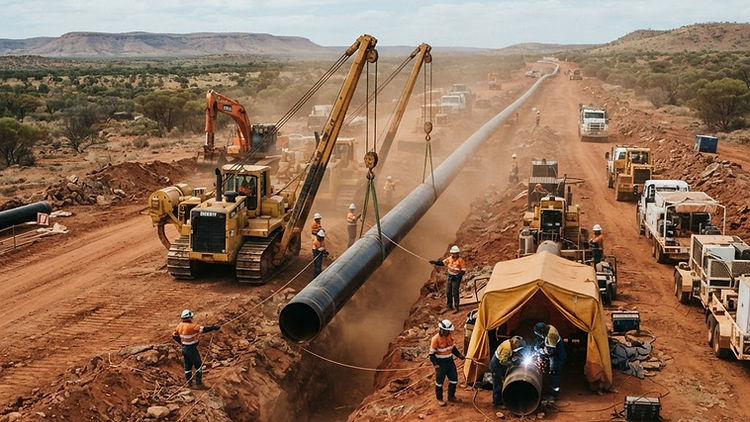
Pipelines are the backbone of the oil, gas and water transport network, moving large volumes over long distances at low unit cost. Transmission systems connect production basins to processing plants, export terminals and demand centres, while gathering networks link individual wells to central facilities and distribution lines deliver gas to end users.
Projects involve route selection, survey and geotechnical investigation, environmental and land access approvals, detailed design, right-of-way clearing, stringing, welding, coating, lowering-in, hydrostatic testing, tie-ins and commissioning. Compressor or pump stations, metering, SCADA and control systems are built alongside the line, and crossings of rivers, roads and sensitive terrain are the most technically demanding segments.
Recent activity spans large gas transmission and export links, offshore gathering and export pipelines tied to deepwater fields, and water pipelines serving mining and irrigation schemes. Repurposing existing gas lines for hydrogen or carbon dioxide transport is emerging as a cheaper alternative to new build, and carbon capture networks are adding dense new gathering systems in industrial clusters.
Procurement is dominated by line pipe, pipe coating, valves, fittings, flanges, pumps, compressors, metering skids and control systems, together with a specialised spread of welding, trenching and coating equipment. Steel tonnage and mill availability often set the pace, and pipeline contractors bid as integrated spreads covering spread labour, equipment and construction management.
The sector's past tracks the growth of the oil and gas industry itself, from the first welded long-distance lines to the multi-thousand-kilometre systems that now cross continents. Regulatory frameworks for integrity management, inspection and emergency response matured alongside the networks, and pipeline operators now run sophisticated integrity programmes to extend asset life.
The future is a mix of new build and repurposing. Hydrogen blending, dedicated hydrogen and carbon dioxide pipelines, methane leak reduction and digital integrity monitoring are all advancing, while safety and land access remain the primary constraints on new routes. Project Atlas tracks pipeline projects, compressor station packages and related tenders as projects move from feasibility through construction.
Integrity and safety obligations extend across the asset's life. In-line inspection, cathodic protection, leak detection and emergency response planning are built into new projects from the outset, and regulators increasingly require digital records and real-time monitoring. Those requirements add instrumentation, communications and software scope to conventional pipeline construction.
Land access and stakeholder consent remain the most common causes of delay. Route changes, cultural heritage requirements and compensation negotiations can each add months, and they often result in additional crossings, longer horizontal directional drills and revised construction methodology. Project Atlas tracks pipeline projects and their line pipe, station and control system packages as they move through approvals.
Explore Pipelines projects
Browse live projects, tenders and procurement activity in this sector.
View projects